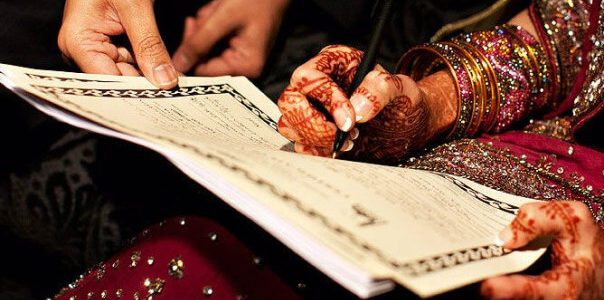

Marriage through Registry Office

Marriage through Registry Office

12th March 2018

السلام عليكم و رحمة الله و بركاته

Question: Please could you give a legal opinion on the following case from a junior doctor based in the UK. I am currently engaged to a woman from a Catholic family. She has decided to revert to Islam, she calls herself Muslim and has renounced any ideas of the Holy trinity et cetera. She is currently scared to tell her family, though, and this may take some time. She wants, as I do, to be married Islamically as well under national law. The questions are:

 1) Do we need to do the Nikah for the marriage to be legal, or is the national registry enough?

2) If we do the Nikah (which ideally we want to), will she need a Wali? The reason this is a problem is that she does not feel ready to tell her father of her change in religion, and she is certain he will refuse to witness the Nikah. I am also fairly certain he will refuse. 


الجواب حامداً و مصلياً

In the name of Allāh, the Most Gracious, the Most Merciful


Answer

In reference to your case scenario, the national registry would suffice only if the integral elements of Nikah were fulfilled namely; offering & acceptance from the bride and groom and the presence of Muslim witnesses either two males or one male and two females. It is, however, advisable to have an Islamic Nikah done in the presence of an Imām either before or after the registry office marriage.

According to the Hanafi School, the presence of a legal guardian during the Nikah ceremony is not essential but just a recommendation. The Nikah will be valid in spite of the absence of her Wali. Nonetheless, it is her moral duty that she informs her parents of the Nikah and persuades them to the best of her ability into accepting it. If they still refuse then that does not affect the validity of their Nikah.


[Allãh Knows Best]


Written by (Mufti) Abdul Waheed

Answer Attested by Shaykh Mufti Saiful Islam

JKN Fatawa Department

Nikāh over the Phone

Nikāh over the Phone

26th July 2016

السلام عليكم و رحمة الله و بركاته

Question: If a Nikāh was conducted over the phone without either of the parties being physically present in the same session, is the Nikāh valid?


الجواب حامداً و مصلياً

In the name of Allāh, the Most Gracious, the Most Merciful


Answer

In reference to your query about performing Nikāh over the phone, the necessary condition for the validity of Nikāh is that all the members; bride, the groom (or representative), witnesses and the Imām must be physically present in the same session. Nikāh being conducted over the phone suggests that all members were not physically present in the same session. Therefore, Islamically the Nikāh conducted in this manner is not valid.

It must be noted that if they consummated assuming that the Nikāh was valid then she must observe a waiting period of three menstrual cycles. This is to clear her womb before she decides to marry someone else. If no consummation took place then no waiting period is to be observed.


[Allãh Knows Best]


Written by (Mufti) Abdul Waheed

Answer Attested by Shaykh Mufti Saiful Islam

JKN Fatawa Department

Giving Jahaiz

Giving Jahaiz

19th January 2015

السلام عليكم و رحمة الله و بركاته

Question: Could you please highlight the issue regarding the Holy Prophet sallallahu alayhi wasallam giving Hadya (gift) to Sayyidunā Ali radhiyallahu anhu at the time of Sayyidah Fātima’s radhiyallahu anha wedding?


الجواب حامداً و مصلياً

In the name of Allāh, the Most Gracious, the Most Merciful

Answer

In reference to your question, the closest Hadeeth to your request is the report where the Messenger of Allāh sallallahu alayhi wasallam prepared (jahaza) for Sayyidah Fātima radhiyallahu anha (at the time of her marriage with Sayyidunā Ali radhiyallahu anhu and relocating them to their new accommodation) a bed sheet, pitcher and a cushion filled with leaves.[1] There is no clear mentioning of giving any gifts directly to Sayyidunā Ali radhiyallahu anhu.

Some have described this as jahaiz where the bride’s parents give some supplementary gifts when giving their daughter away in marriage. With the exception of Sayyidah Fātima radhiyallahu anha, there is no sound report where the Messenger of Allāh sallallahu alayhi wasallam did the same with his other daughters at the time of their marriage. This establishes that it was not his regular habit to do such a thing and moreover, the jahaiz for Sayyidah Fātima radhiyallahu anha and her husband were, in fact, their basic essentials because jahaiz comes from the root word ja-ha-za which means preparing one’s essentials.

So, albeit giving jahaiz at the time of giving one’s daughter away in marriage is not an emphasised Sunnah, there is no harm in gifting items generally without extravagance or coercion from anyone. The above Hadeeth cannot be used as evidence to make it an emphasised tradition nor to justify modern-day extravagance in gifts during wedding ceremonies.


[Allãh Knows Best]


Written by (Mufti) Abdul Waheed

Answer Attested by Shaykh Mufti Saiful Islam

JKN Fatawa Department

[1] Sunnan Nasai, Chapter on man giving Jihaz to his daughter Hadeeth No:3384

عَنْ عَلِيٍّ، رَضِيَ اللَّهُ عَنْهُ قَالَ: «جَهَّزَ رَسُولُ اللَّهِ صَلَّى اللهُ عَلَيْهِ وَسَلَّمَ فَاطِمَةَ فِي خَمِيلٍ وَقِرْبَةٍ وَوِسَادَةٍ حَشْوُهَا إِذْخِرٌ

Financial Expenses

Financial Expenses

4th April 2014

السلام عليكم و رحمة الله و بركاته

Question: I am in need of guidance regarding a particular problem I have. My husband’s income is sufficient to cover the household bills, half house payment and car costs and prior to us marrying some 18 years ago, he agreed that I could continue working if I wished after marriage and this helped with mine and the house expenses (my clothing, car) the children’s clothes, items, school costs, dinners, house furnishings etc. Regarding Islamic ruling of a wife ‘taking’ from a husband’s property if he is not maintaining her and the children’s expenses like school fees, would I be able to do this here?

الجواب حامداً و مصلياً

In the name of Allāh, the Most Gracious, the Most Merciful

Answer

According to the Islamic principle, it is the husband who is primarily responsible to financially support and maintain the home and family essentials, adequate for living. Even though the wife has arranged alternative financial means for herself (e.g. through employment), she is not obliged to contribute financially and the husband must still financially support her and his children.[1] Other than basic food, clothing and a reasonable standard accommodation, paying off house hold bills, rental accommodation and children’s fee, all come under financial obligation, which the husband must initially provide.

If he allowed you to continue working after marriage and the financial contribution was divided between you both, as in, there was mutual agreement between both of you as to who will take financial responsibility in specific areas, then you must fulfil it within your capacity and abide by the initial agreement.

This being the case then you cannot take from him without his consent any additional money for that which you already agreed to contribute. You may however, take without his consent the necessary amount to pay off what he agreed to contribute when he fails to fulfil his part of agreement. [2]   

[Allãh Knows Best]

Written by (Mufti) Abdul Waheed

Answer Attested by Shaykh Mufti Saiful Islam

JKN Fatawa Department

[1] Fatawa Hindiyyah, Book of Talaq, Chapter on Expenses,  p. 568 vol 1

الْفَصْلُ الْأَوَّلُ فِي نَفَقَةِ الزَّوْجَةِ تَجِبُ عَلَى الرَّجُلِ نَفَقَةُ امْرَأَتِهِ الْمُسْلِمَةِ وَالذِّمِّيَّةِ وَالْفَقِيرَةِ وَالْغَنِيَّةِ

[2] Bukhari, Chapter of a man who does not spend then his wife can take what suffices her, Hadeeth No: 5364

Sayyidah A’isha (ra) relates, “Hind Bint Utbah (ra) said, ‘O Messenger of Allah (saw), verily Abu Sufyan (her husband) is a stingy man and does not give me what suffices for me and my child except what I take from him whilst he does not know of it (i.e. what I take without seeking his permission).’ He said,’ Take what suffices for you and your child (but) with kindness.’”   

Wife Taking Money from her Husband without His Consent

Wife Taking Money from her Husband without His Consent

4th April 2014

السلام عليكم و رحمة الله و بركاته

 Question: I am in need of guidance regarding a particular problem I have. My husband’s income is sufficient to cover the household bills, half house payment and car costs and prior to us marrying some 18 years ago, he agreed that I could continue working if I wished after marriage and this helped with mine and the house expenses (my clothing, car) the children’s clothes, items, school costs, dinners, house furnishings etc. Regarding the Islamic ruling of a wife ‘taking’ from a husband’s property if he is not maintaining her and the children’s expenses like school fees, would I be able to do this here?

الجواب حامداً و مصلياً

In the name of Allāh, the Most Gracious, the Most Merciful

Answer

According to the Islamic principles, it is the husband who is primarily responsible to financially support and maintain the home and family essentials, adequate for living. Even though the wife has arranged alternative financial means for herself (e.g. through employment), she is not obliged to contribute financially and the husband must still financially support her and his children.[1] Other than basic food, clothing and reasonable standard accommodation, paying off household bills, rental accommodation and children’s fee, all come under financial obligation, which the husband must initially provide.

If he allowed you to continue working after marriage and the financial contribution was divided between you both mutually, as in, you both allocated financial responsibilities between yourselves, then you must fulfil your part of the agreement within your capacity.

That being the case, you cannot take from him without his consent any additional money for that which you already agreed to contribute to. You may, however, take without his consent the necessary amount to pay off what he agreed to contribute towards upon failing to fulfil his part of the agreement. [2]


[Allãh Knows Best]

Written by (Mufti) Abdul Waheed

Answer Attested by Shaykh Mufti Saiful Islam

JKN Fatawa Department

[1] Fatawa Hindiyyah, Book of Talaq, Chapter on Expenses, p. 568 vol 1

الْفَصْلُ الْأَوَّلُ فِي نَفَقَةِ الزَّوْجَةِ تَجِبُ عَلَى الرَّجُلِ نَفَقَةُ امْرَأَتِهِ الْمُسْلِمَةِ وَالذِّمِّيَّةِ وَالْفَقِيرَةِ وَالْغَنِيَّةِ

[2] Bukhari, Chapter of a man who does not spend then his wife can take what suffices her, Hadeeth No: 5364

Sayyidah A’isha (ra) relates, “Hind Bint Utbah (ra) said, ‘O Messenger of Allah (saw), verily Abu Sufyan (her husband) is a stingy man and does not give me what suffices for me and my child except what I take from him whilst he does not know of it (i.e. what I take without seeking his permission).’ He said,’ Take what suffices for you and your child (but) with kindness.’”